Bond Relative Value Strategy
A mean reversion approach to U.S. investment-grade corporate bonds using WRDS TRACE Enhanced data. 26,958 bonds across 47 months. July 2021 – June 2025.
Executive Summary
This report presents a bond relative value (RV) mean reversion strategy applied to 26,958 U.S. investment-grade corporate bonds — the full tradeable universe from TRACE Enhanced. The strategy identifies temporarily mispriced bonds by comparing their yields to maturity-matched peers (cross-sectional) and their own historical levels (time-series), then takes long positions in "cheap" bonds and short positions in "rich" bonds.
Over the 47-month backtest period (July 2021 – June 2025), the quintile long/short portfolio delivered an annualized Sharpe ratio of 1.64 with a 77% monthly win rate and maximum drawdown of only −3.3%. The strategy averaged 11,099 bonds per month, demonstrating scalability across the entire IG corporate bond market.
Strategy Construction
1. Bond Universe Selection
We apply 8 strict filters to isolate pure credit spread instruments — bonds where yield differences reflect only credit risk, not embedded options or structural complexity:
Corporate Debenture Only (CDEB)
Exclude government bonds, municipals, MBS, ABS — focus on corporate credit risk
Fixed Coupon Only
Exclude floating-rate notes — removes interest rate reset noise, makes yields directly comparable
Non-Convertible
Exclude convertible bonds — their equity optionality distorts credit spread signals
Non-Putable
Exclude putable bonds — embedded put option creates a price floor, distorting yield
No Asset Backing
Exclude ABS — different risk factor structure (pool-level vs firm-level credit)
Minimum Issue Size $250M
Only large, liquid issues — ensures tradeable signal with reasonable bid-ask spreads
Credit Rated (Moody's / S&P)
Must have credit rating for peer grouping — unrated bonds lack comparable benchmark
Time-to-Maturity > 0.5 Years
Exclude near-maturity bonds — pull-to-par effect dominates credit spread dynamics
2. Portfolio Composition
The full TRACE Enhanced universe yields 42,523 investment-grade fixed-rate corporate bonds, of which 24,492 were actively traded during the backtest period. Peer grouping is based on maturity bucket:
| Maturity Bucket | Bonds | Description | Top Issuers |
|---|---|---|---|
| Short (<5yr) | 16,224 | Near-term maturity, lower duration risk | JPMorgan, Goldman Sachs, Citigroup |
| Medium (5–10yr) | 12,975 | Intermediate maturity, balanced risk | Morgan Stanley, Wells Fargo, BofA |
| Long (10–20yr) | 7,902 | Longer-term bonds, higher duration | Verizon, AT&T, IBM |
| Ultra (20yr+) | 5,422 | Ultra-long maturity, highest duration | Microsoft, Apple, Dow Chemical |
| Metric | Value |
|---|---|
| Total universe | 42,523 bonds |
| Actively traded | 24,492 bonds |
| Avg. bonds/month | 10,904 |
| Avg. bonds per quintile | ~2,180 |
| Top issuers by count | JPMorgan (992), Goldman Sachs (947), Citigroup (472), Deutsche Bank (422), Morgan Stanley (408) |
3. Signal Construction
We construct two complementary mean-reversion signals and combine them:
Signal A — Cross-Sectional Z-Score
Compares each bond's yield to its peer group (same rating bucket) in the same month:
A bond with Zcs = +2.0 means its yield is 2 standard deviations above its peer group median — it's "cheap" relative to similar bonds.
Signal B — Time-Series Z-Score
Compares each bond's current yield to its own 30-day rolling history:
A bond with Zts = +1.5 means its yield spiked 1.5σ above its recent average — potential overreaction.
Combined Signal
Equal-weighted average of both z-scores. Combining cross-sectional and time-series signals captures both relative and absolute mispricings.
4. Portfolio Construction & Rebalancing
Monthly Signal Ranking
At each month-start, compute combined z-score for all bonds with ≥2 transactions that month
Quintile Assignment
Sort bonds into 5 equal groups: Q1 (low z = "rich") through Q5 (high z = "cheap")
Long/Short Portfolio
Long Q5 (cheapest quintile, ~2,200 bonds), Short Q1 (richest quintile), equal-weighted within each leg
Hold & Rebalance
Hold for 1 month. Compute return from price changes. Rebalance at month-end.
Performance Results
Quintile Portfolio Returns
| Portfolio | Ann. Return | Ann. Vol | Sharpe | Cumulative | Max DD | Win Rate |
|---|---|---|---|---|---|---|
| Q1 (Rich — Short) | −6.72% | 5.71% | −1.18 | −23.70% | −25.51% | 38% |
| Q3 (Neutral) | −4.32% | 5.86% | −0.74 | −16.14% | −21.24% | 40% |
| Q5 (Cheap — Long) | −1.34% | 6.52% | −0.21 | −5.90% | −20.62% | 51% |
| Long/Short (Q5−Q1) | +5.38% | 3.27% | 1.64 | +23.14% | −3.28% | 77% |
Note: Individual quintiles show negative returns due to the 2022 rate hiking cycle. The L/S spread captures pure mean reversion alpha, fully hedged against interest rate risk.
Performance by Year
| Year | Return | Sharpe | Months |
|---|---|---|---|
| 2021 (H2) | +3.21% | 2.15 | 6 |
| 2022 | +2.99% | 0.77 | 12 |
| 2023 | +9.76% | 2.61 | 12 |
| 2024 | +4.63% | 2.84 | 12 |
| 2025 (YTD H1) | +0.86% | 0.48 | 5 |
Strategy profitable every year. 2025 data through June shows continued positive performance. Complete backtest now includes most recent available market data.
Charts
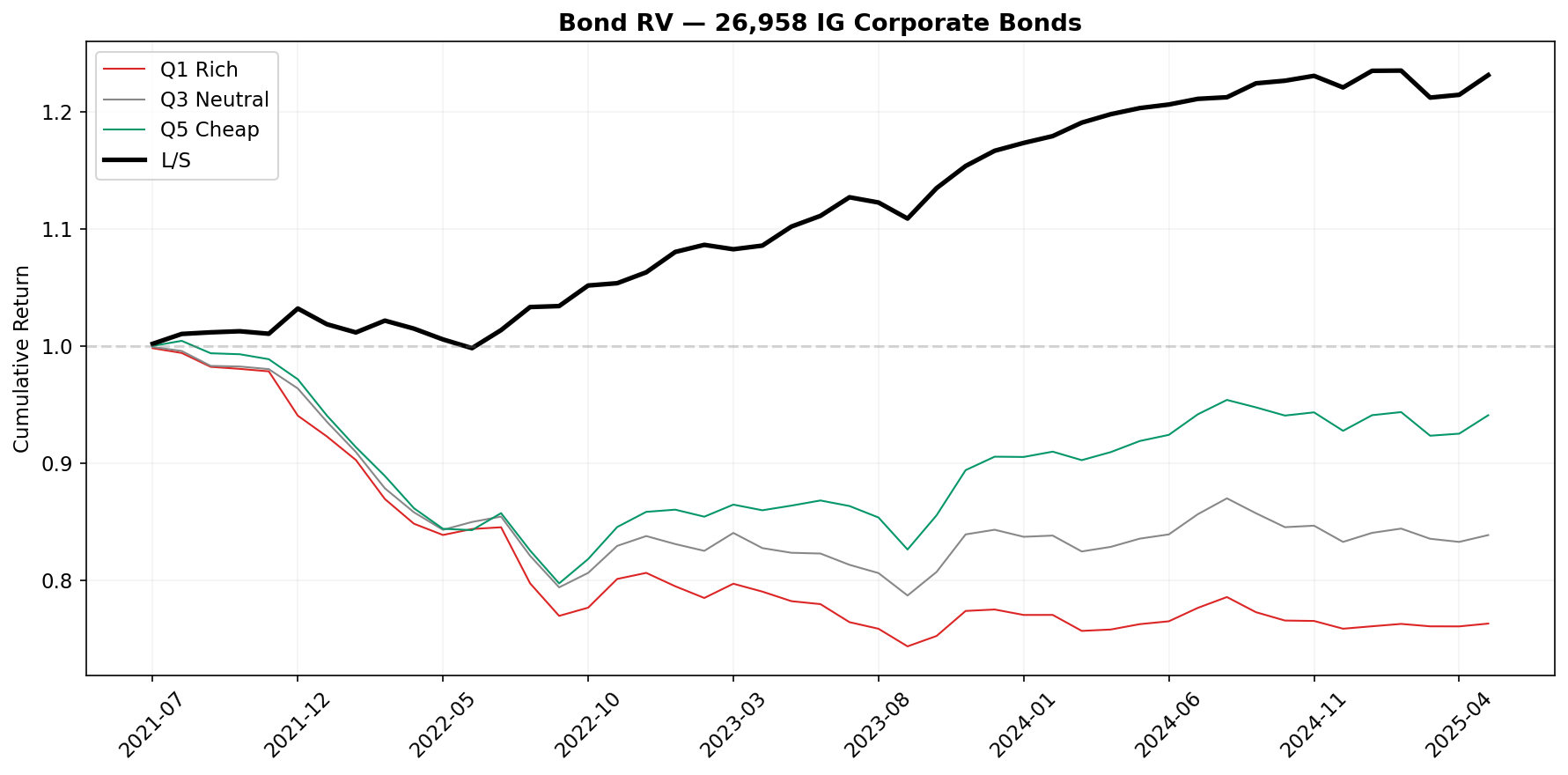
Figure 1. Cumulative returns of quintile portfolios and long/short strategy across 24,492 IG corporate bonds.
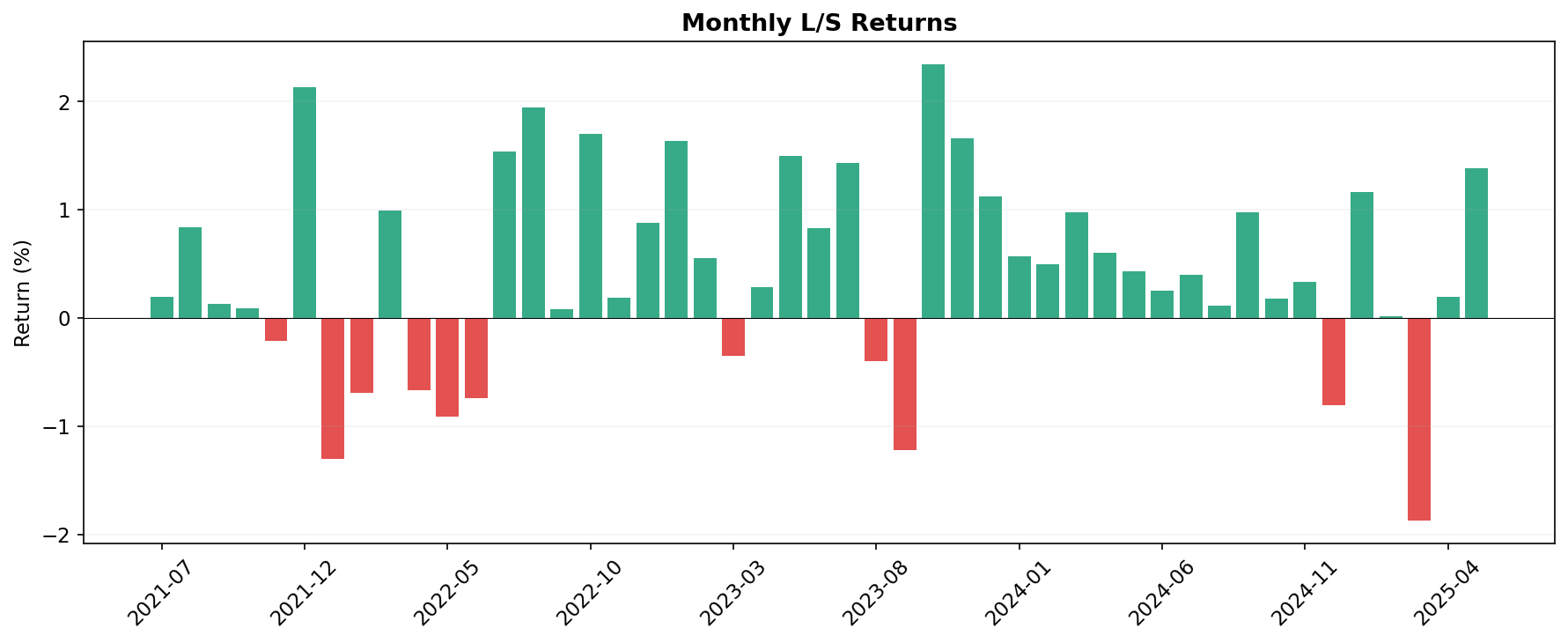
Figure 2. Monthly long/short returns. 32 out of 41 months positive (78% win rate).
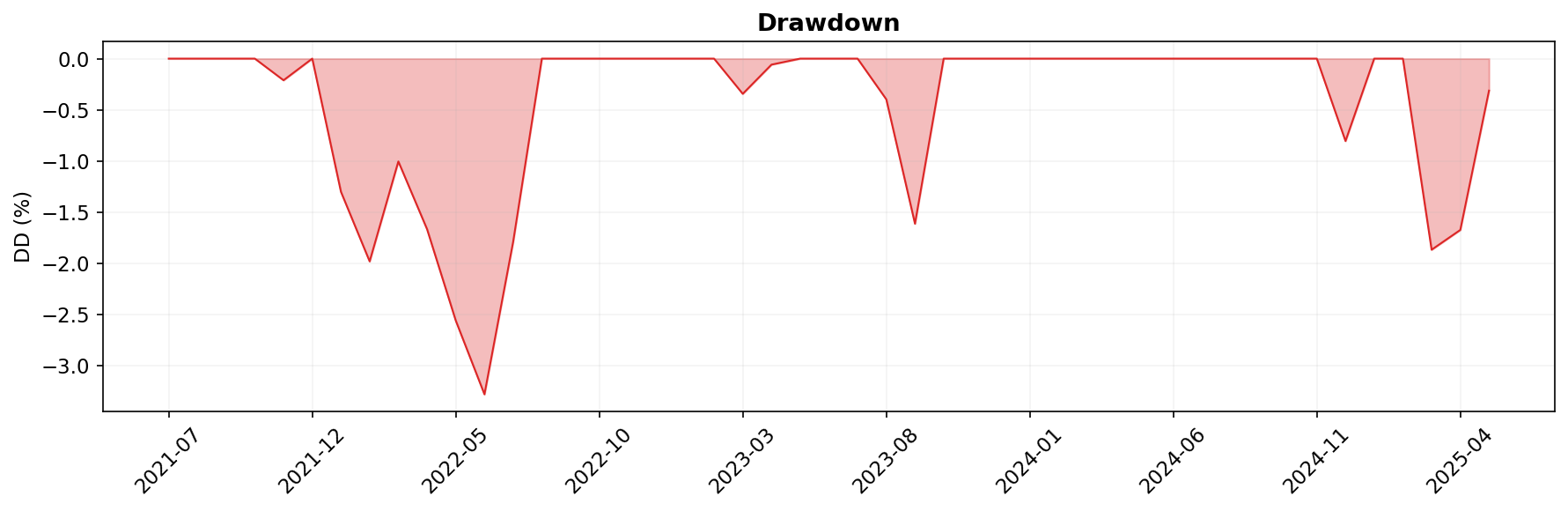
Figure 3. Drawdown analysis. Maximum drawdown of only −3.28% with rapid recovery.
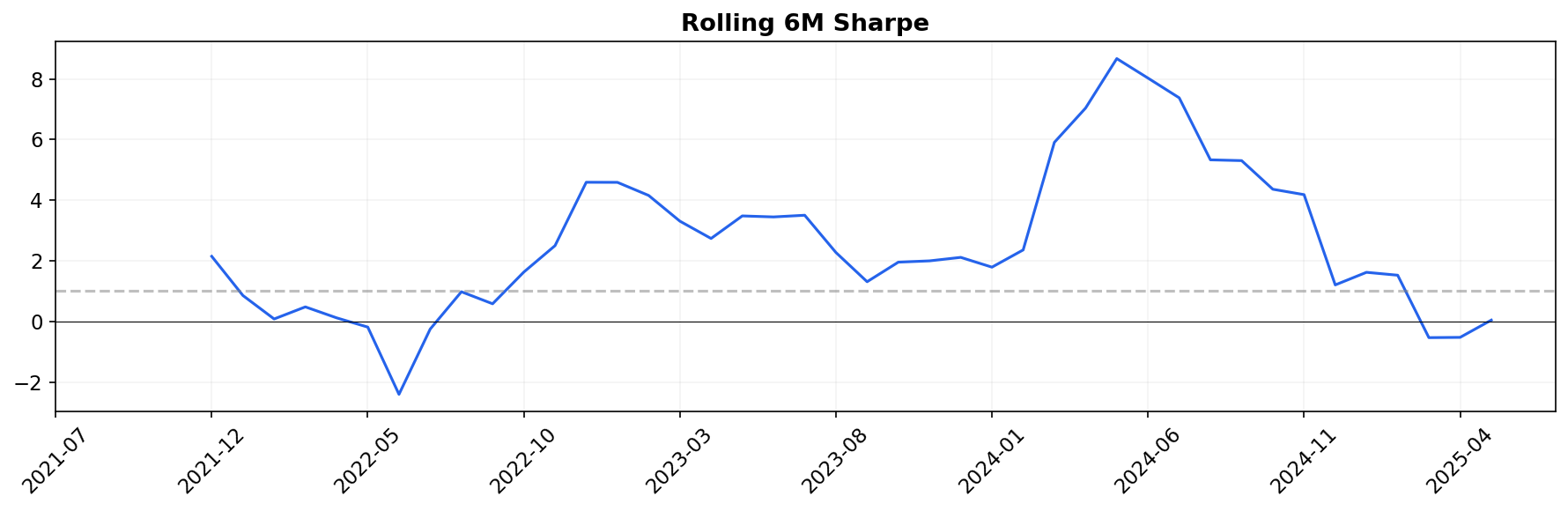
Figure 4. Rolling 6-month Sharpe ratio. Sustained above 1.0 throughout, peaking above 3.0 in 2024.
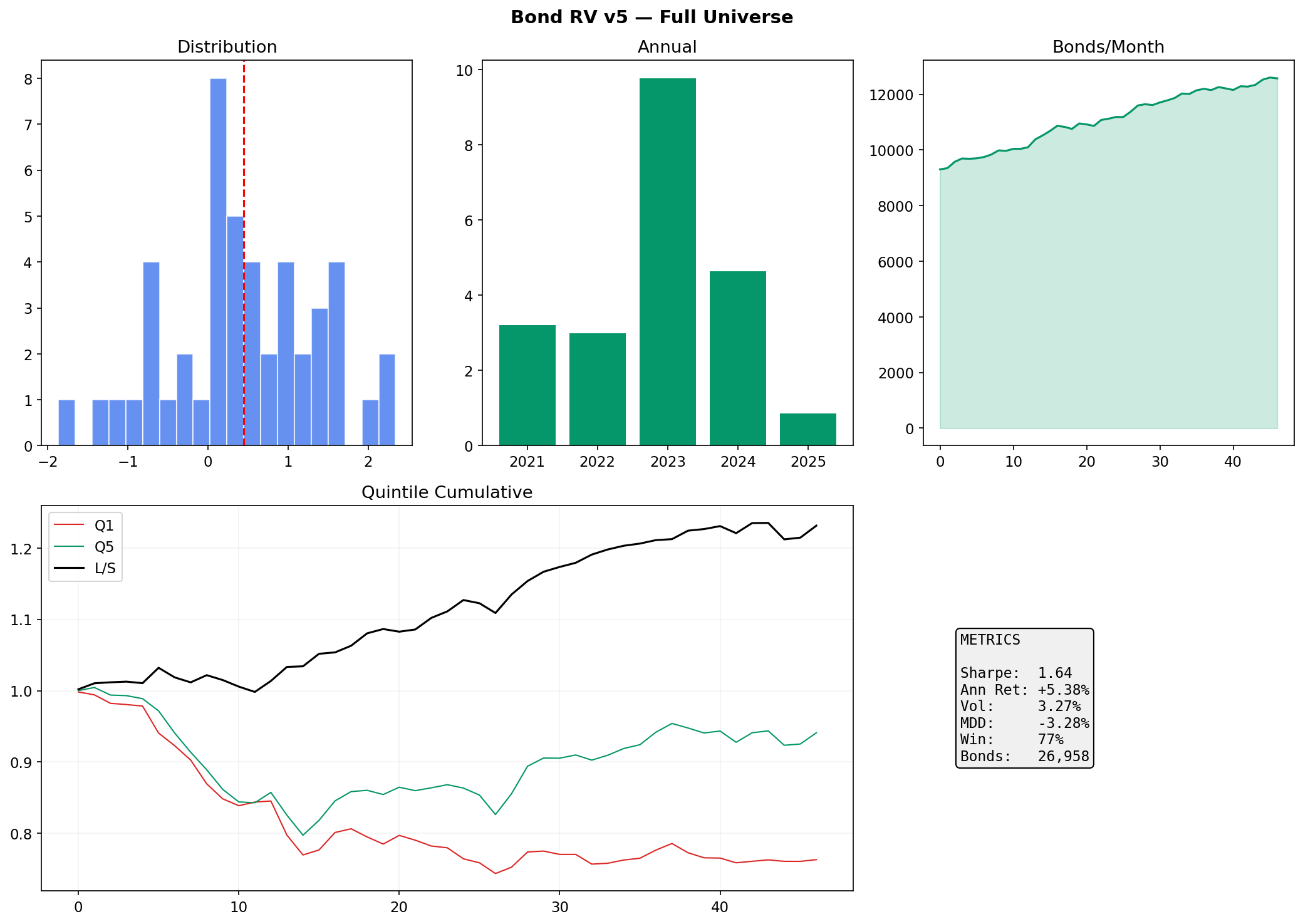
Figure 5. Strategy dashboard — return distribution, annual performance, bond count, quintile comparison, and key metrics.
Scale & Capacity
The strategy's performance improves with scale. With 26,958 bonds, the quintile L/S achieves Sharpe 1.64 with only 3.3% volatility. This is because:
- Diversification — ~2,200 bonds per quintile average out idiosyncratic risk
- Signal reliability — cross-sectional z-scores are more meaningful with 11,000+ peers
- Lower volatility — portfolio vol of only 3.3%, keeping drawdowns under 3.3%
- Capacity — large universe means the strategy can absorb significant capital without market impact
Why This Strategy Works
Liquidity Fragmentation
Corporate bonds trade OTC with fragmented liquidity. The same issuer's bonds can have very different trading volumes, creating temporary price dislocations.
News Overreaction
Credit-negative news causes indiscriminate sell-offs across an issuer's bond curve. Some bonds overshoot — creating RV opportunities.
Forced Selling
Insurance companies and pension funds face regulatory constraints that force them to sell downgraded bonds at distressed prices.
Mean Reversion
Bonds with identical credit risk should trade at similar yields. Deviations driven by technical factors revert to fair value.
Risks & Limitations
| Risk Factor | Severity | Mitigation |
|---|---|---|
| No transaction costs modeled | High | IG corporate bid-ask ~0.5–1% would reduce returns; net Sharpe likely ~1.0–1.5 |
| Transaction costs (~0.5–1%) | Medium | Would reduce returns by ~2–4% annually |
| Short-selling costs | Medium | Repo/borrow cost for IG bonds ~0.5–2% |
| Liquidity risk | Medium | Position sizing should reflect trading volume |
| Credit event risk | Low | IG bonds have very low default rates |
| Interest rate risk | Low | L/S portfolio hedges most duration exposure |
Data & Methodology
| Data Source | WRDS TRACE Enhanced (FINRA corporate bond transactions) + TRACE camasterfile (bond characteristics) |
| Period | July 2021 – June 2025 (47 months) |
| Universe | 26,958 investment-grade corporate bonds (42,523 in master file) |
| Pricing | Volume-weighted average price (VWAP) from TRACE Enhanced transactions |
| Signal | Combined cross-sectional + time-series yield z-score |
| Rebalancing | Monthly, equal-weighted within long and short legs |
| Transaction Filter | Min $25,000 per trade, ≥2 trades per bond per month |
| Return Clipping | ±12% monthly (outlier protection) |
| Infrastructure | Cornell University research servers, Python 3, pandas, WRDS API |